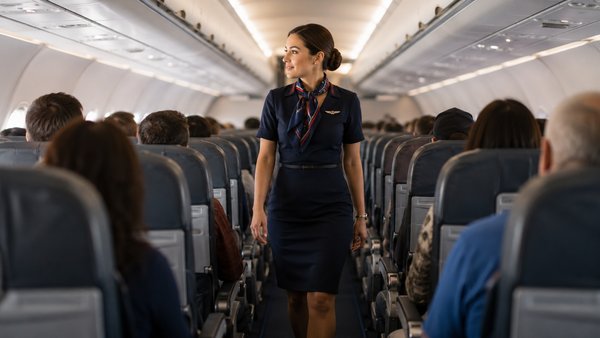
Regional Flight Attendant Salary: My First-Year Pay, Honestly Explained
Regional flight attendant salary from a first-year crew member: hourly rates, per diem, reserve pay, and what my actual paychecks look like in 2026.


Regional flight attendant salary from a first-year crew member: hourly rates, per diem, reserve pay, and what my actual paychecks look like in 2026.
Key Takeaways
- Regional flight attendants typically earn $24–$32 per flight hour in 2026, but are only paid for "block time" — when the aircraft door is closed.
- First-year monthly take-home at a regional carrier usually lands between $2,200 and $3,200, including per diem.
- A 75-hour guarantee is standard; anything above it is paid at premium or straight rates depending on the contract.
- Per diem ($2.00–$2.70/hour, tax-free while on trips) adds $350–$600/month and is the most misunderstood part of the paycheck.
- The pay curve is steep: by year 5, hourly rates climb roughly 40–50% above year one.
What My First-Year Paycheck Actually Looks Like
The short answer: a regional flight attendant salary in 2026 starts around $24–$32 per flight hour, which works out to roughly $2,200–$3,200 per month flying a standard 75–85 hour schedule. That number surprises people — in both directions. Some expect glamour money; others expect minimum wage. The truth is more complicated, because flight attendant pay works unlike almost any other job in America.I'm in my first year working the cabin for a regional airline. I've flown reserve months and line months, and I've opened enough paychecks now to understand exactly where the money comes from — and where it doesn't. Before I took this job, I spent weeks trying to find one honest breakdown of regional pay written by someone actually living it. I never found it. So I'm writing it.This article is for anyone considering the career, anyone holding a conditional job offer from a regional carrier, and any passenger who has ever wondered what the crew serving them actually earns.Let's break the paycheck down line by line.
How Regional Flight Attendant Pay Actually Works
You Are Paid by the Flight Hour — Not the Work Hour
The single most important thing to understand about a regional flight attendant salary is block time. We are paid from the moment the aircraft door closes and the parking brake releases, until the door opens at the destination. Boarding, deplaning, delays at the gate with the door open, sitting on the airport floor between flights — unpaid.A "12-hour duty day" might only contain 6.5 credit hours of pay. That ratio shocked me in my first month, and it's the number-one reason first-year flight attendants feel underpaid. Nobody explained it clearly during the hiring process — they advertise the hourly rate, not the ratio.
The 75-Hour Monthly Guarantee
Most regional contracts guarantee around 75 credit hours per month. Fly less, you still get the guarantee. Fly more, the extra hours pay on top — sometimes at 150% if the company is short-staffed and offering premium pay.At $27/hour, the guarantee is $2,025 before anything else. That's the floor, not the ceiling.
Per Diem — The Hidden Second Paycheck
Per diem is a tax-advantaged hourly allowance (typically $2.00–$2.70/hour at regionals in 2026) paid for every hour you're away from base, from check-in to check-out. On a 4-day trip, that's 80+ hours of per diem — around $180–$220 per trip.Flying 4 trips a month can add $350–$600 in per diem. It doesn't show up in salary calculators, which is why sites like the Bureau of Labor Statistics undercount what crew actually take home. (The BLS reports a median annual wage of $67,130 for flight attendants as of May 2024 — but that's dominated by mainline carriers with decades of seniority, not first-year regional crew like me.)
Regional Flight Attendant Salary by Seniority
Here's what the ladder looks like at a typical US regional carrier — I've compared my own contract rates with what crew members at other regionals report:Table
| Seniority | Hourly Rate | Est. Monthly (75–85 hrs + per diem) | Est. Annual |
|---|---|---|---|
| Year 1 (me) | $24–$27 | $2,200–$2,800 | $27k–$34k |
| Year 3 | $28–$31 | $2,600–$3,300 | $32k–$40k |
| Year 5 | $32–$36 | $3,000–$3,900 | $38k–$48k |
| Year 10+ | $38–$45 | $3,600–$4,800 | $45k–$58k |
Figures are representative ranges compiled from regional carrier contracts and crew-reported pay in 2025–2026; exact rates vary by airline and union contract.Two honest observations from my first year:
- Year one is genuinely tight. Most of my training class needed roommates, crash pads, or family support. Anyone who tells you otherwise is selling you something.
- The curve is steep. The jump from year 1 to year 5 is roughly 40–50% — the fastest pay growth most people will ever see in a job. The senior crew I fly with keep telling me the same thing: survive year one.
Regional vs. Mainline Pay — Should You Wait?
This was my biggest question before I accepted my regional offer: "Should I hold out for Delta, United, or American?"Mainline carriers pay more at every step — top-out rates above $70/flight hour for senior mainline crew versus the mid-$40s at regionals. But mainline hiring is brutally competitive (acceptance rates below 2% in some hiring windows), and 2026 hiring has cooled compared to the 2022–2023 surge.What I concluded, and what I'd tell anyone in my old position:
- If you get a mainline offer, take it. The lifetime earnings difference is real.
- If you don't, a regional is not a consolation prize — it's a launchpad. Two to three years of regional experience makes you dramatically more competitive for mainline classes, and some regionals have flow-through agreements that guarantee eventual mainline placement.
- Don't romanticize mainline schedules. The senior flight attendants on my trips — people who turned down mainline moves years ago — often have better quality of life (shorter trips, home more nights) than junior mainline reserve crew, even on less money.
5 Things That Quietly Raise (or Cut) Your Regional Paycheck
- Premium pay pickups. When weather or staffing melts the operation down, the company pays 150–200% for extra flying. I watched a crew member add $700 to a single month this way.
- Holiday pay. Working Thanksgiving or Christmas often pays time-and-a-half on top of per diem.
- Lead/purser position pay. Flying as the lead on a regional jet adds $1–$3/hour — worth bidding for as soon as you're eligible.
- Per diem on long sits. A 30-hour layover is per-diem gold. Senior crew bid these trips on purpose, and now I understand why.
- The crash pad trap. If you commute to base, a crash pad runs $200–$400/month. New hires who don't budget for this feel broke even on a decent line. Ask me how I know.
Frequently Asked Questions
How much do regional flight attendants make a month?
A first-year regional flight attendant typically takes home $2,200–$3,200 per month in 2026, combining the 75-hour guarantee, per diem, and any extra flying. Monthly income varies seasonally and with schedule type — reserve months usually pay less than line-holder months with premium pickups.
Do flight attendants get paid during boarding?
No. At most US airlines, flight attendants are paid only for block time — door closed to door open. Boarding, deplaning, and gate delays with the door open are unpaid work time. This is one of the most contested issues in current union contract negotiations across the industry.
Is regional flight attendant pay worth it?
Financially, years 1–2 are lean but years 3–5 improve fast, with pay rising roughly 40–50%. The career payoff is the leverage: regional experience unlocks mainline opportunities where senior crew earn $100k+. If you treat the regional years as paid training, the math works.
How does per diem work for flight attendants?
Per diem is an hourly allowance ($2.00–$2.70/hour at most regionals) paid for every hour you're on a trip away from base. It's not taxed like regular wages within IRS limits, and it typically adds $350–$600 per month for a full schedule.
Can you live on a regional flight attendant salary?
Yes, but year one requires planning: roommates or a crash pad, a base with a reasonable cost of living, and a budget for commuting. By year three, most regional flight attendants live comfortably on their income alone, especially in lower-cost base cities.
The Bottom Line
A regional flight attendant salary won't make you rich in year one — $24–$32 per flight hour, $2,200–$3,200 a month, paid only when the door is closed. I'm living that reality right now. But the pay curve is steep, per diem quietly adds hundreds a month, and these regional years are the single best launchpad into a six-figure mainline career.If you're weighing a conditional job offer, here's the advice my training class kept passing around, and it holds up: take the job, learn the operation, protect your credit, and bid smart — the money follows the seniority.Have questions about regional pay, reserve life, or the hiring process? Drop them in the comments — I'm living this right alongside you, and I answer every one.